Best Multicolor 3D Printer for Beginners: What to Buy and What to Skip
Best Multicolor 3D Printer for Beginners: What to Buy and What to Skip
Multicolor 3D printing is one of those features that looks simple from the outside and becomes much more nuanced once you start comparing machines. On paper, nearly every newer printer promises faster printing, easier setup, and smarter automation. In practice, a beginner usually needs something more specific: a printer that is predictable, easy to calibrate, and forgiving when things go wrong. That matters far more than raw speed or eye-catching marketing.
I think this is where many first-time buyers get pushed in the wrong direction. They search for the best multicolor 3d printer for beginners and end up looking at machines that are either too limited to grow with them or too advanced to feel relaxing in everyday use. The goal of this guide is to help you buy with clear expectations. I will also point out what to skip, where real costs show up, and which current Creality options make sense depending on your budget and projects.
For transparency: this article may earn a commission from qualifying purchases. Prices, coupons, and bundle offers can change on Amazon, so it is always smart to check the current price before buying.
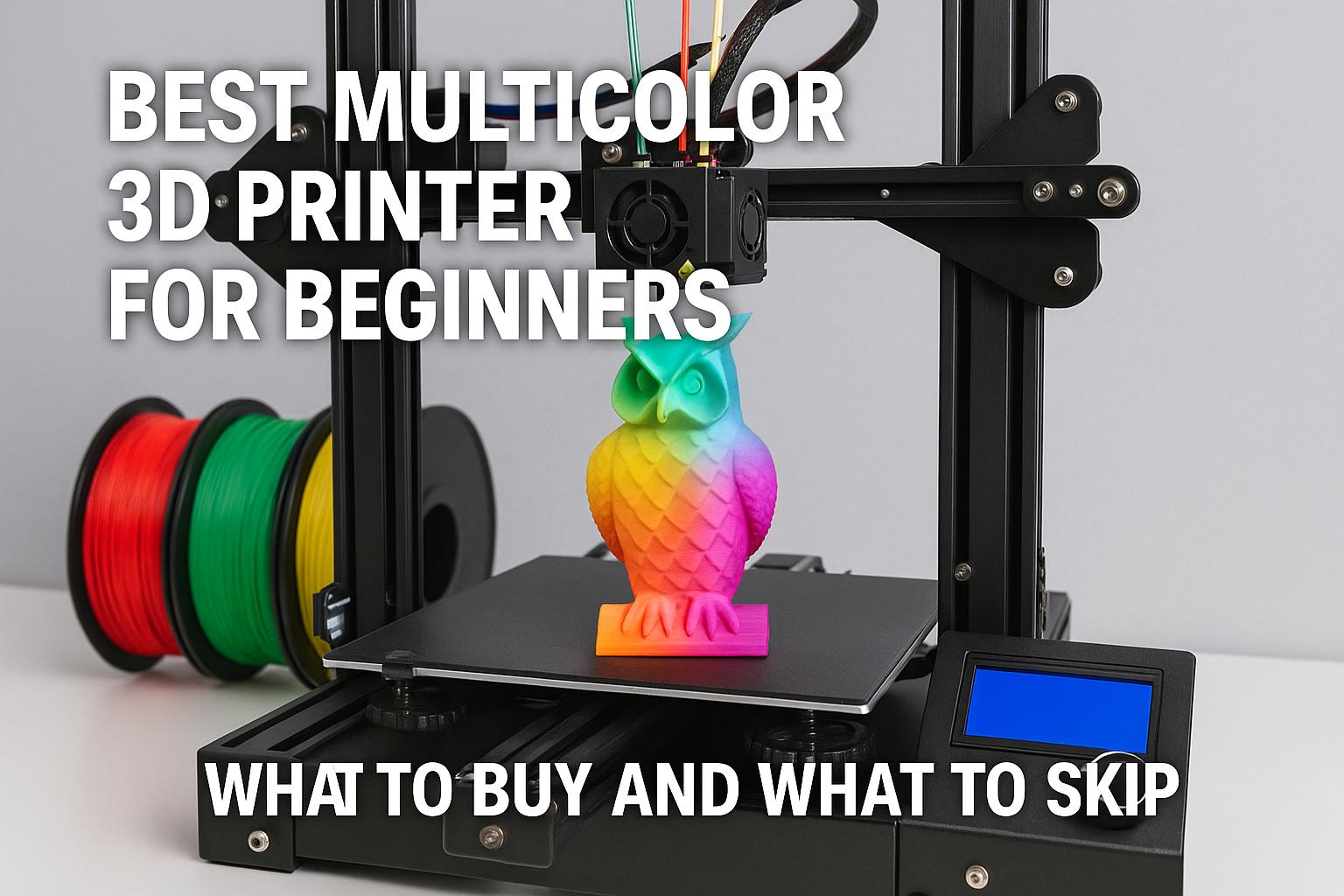
If you are comparing current Creality models, pay close attention to whether CFS is included or sold separately. That detail changes both the real price and the out-of-box multicolor experience.
What Makes a Multicolor 3D Printer Beginner Friendly
In my view, a beginner-friendly machine is not necessarily the cheapest one. It is the one that removes unnecessary friction while still leaving room to learn. For multicolor printing, that means setup quality, software clarity, and consistency matter even more than on a basic single-color machine.
Easy setup and guided calibration
A good beginner printer should reach its first successful print without demanding hours of manual tuning. Auto leveling, guided setup routines, and sensible defaults make a huge difference. When a machine walks you through calibration and catches common errors early, it stops feeling like a project and starts feeling like a tool. That is especially important for anyone shopping for the best 3d printer for beginners that just works.
Reliable printing with low maintenance
Multicolor systems add moving parts, filament changes, and more opportunities for failed transitions. A machine that already has a reputation for clogging, weak feeding, or inconsistent bed adhesion becomes much more frustrating in color work. Beginners should prioritize reliability over experimental features. From what I see in the market, enclosed printers and pre-assembled platforms often feel calmer and less intimidating for home users.
Simple software and clear user support
Software is often underestimated. You may have a mechanically capable printer, but if the slicer workflow is confusing, color assignment is messy, or support documentation is thin, the learning curve gets steep. Clear tutorials, active communities, and spare-parts availability can save enormous time. For anyone looking for the best 3d printer for kids and beginners or the best quiet 3d printer for apartment, this usability layer matters just as much as print hardware.
“A beginner printer should reduce uncertainty, not create more of it.”
How Multicolor Printing Works
Before choosing a model, it helps to understand that “multicolor” does not always mean the same thing. Some machines switch filaments through one nozzle, while others use multiple extruders or more advanced material handling. The results can look similar in product photos, but the tradeoffs are not.
Single nozzle systems with filament switching
This is one of the most common approaches in consumer multicolor printing. A machine uses a single nozzle and swaps between different filaments during the print. The main advantage is simplicity in hardware. The downside is that color changes often create purge waste and can increase print times. For a beginner, this can still be a reasonable compromise if the software and filament system are well integrated.
Dual extruder and multi material options
Dual extruder systems can handle two materials or colors more directly, and some setups are better suited for soluble supports or mixed-material workflows. However, they can also be more demanding to maintain and calibrate. Unless you already know why you need dual extrusion, I would not automatically recommend it as a first step.
Tradeoffs in speed, waste, and print quality
Every multicolor method involves compromise. Filament-switching systems may waste material during purging. Faster machines may print quicker on paper, but actual multicolor jobs can still stretch out because of repeated swaps. Print quality can also vary depending on how cleanly a printer handles transitions. This is why I usually suggest buyers focus less on the promise of “up to 16 colors” and more on whether the whole system feels manageable in daily use.
Key Features to Compare Before Buying
Once you move past the marketing terms, a few features consistently separate a pleasant beginner experience from a frustrating one. These are the points I would compare first if I were buying today.
Build volume, resolution, and print speed
Build volume shapes what you can realistically make. If you want props, cosplay parts, classroom models, or Etsy-ready batches, larger volume has clear value. If you mainly want toys, décor, or compact prototypes, a desktop machine may be enough. Speed is useful, but only when reliability stays high. Some shoppers looking for the best large format 3d printer for cosplay or the best 3d printer for cosplay helmets should lean toward bigger enclosed machines rather than budget desktop models.
Auto leveling, enclosed design, and safety features
Auto leveling is close to essential for beginners now. It cuts down on one of the most common causes of failed prints. Enclosed designs help with safety, noise control, and temperature management, which can be particularly helpful in apartments or shared rooms. That is also why the search for the best enclosed 3d printer for beginners is so common: the enclosure adds convenience, not just style.
Material compatibility and upgrade potential
Not every beginner stays a beginner for long. Some users quickly move from PLA into PETG, ABS, ASA, or carbon-fiber blends. Others need a printer that supports future multicolor expansion. A machine with an upgrade path can be far better value than a very cheap printer you outgrow in six months. For side hustles, prototyping, or education, this long-term flexibility matters. It is often what separates the best 3d printer for etsy sellers or the best 3d printer for small business from an ordinary hobby machine.
| Property | What beginners should prioritize | Why it matters |
|---|---|---|
| Setup | Pre-assembled or quick assembly | Less friction and fewer early mistakes |
| Leveling | Automatic leveling | Improves first-layer consistency |
| Noise | Quiet mode or enclosed frame | Better for apartments and shared rooms |
| Multicolor system | Clear CFS support details | Avoids confusion over what is included |
| Build volume | Matched to your actual projects | Prevents overspending or outgrowing the printer too soon |
| Support | Good documentation and parts access | Makes ownership easier over time |
Best Types of Multicolor 3D Printers for First Time Buyers
Not every beginner needs the same kind of printer. In fact, the best choice depends less on skill level alone and more on whether you want to learn casually, produce at scale, or grow into more demanding materials and larger prints.
Plug and play models for ease of use
If your top priority is simplicity, pre-assembled printers with auto leveling and guided setup are the safest path. These are the machines I would recommend to buyers looking for the best 3d printer for beginners that just works. They let you focus on slicing, materials, and design rather than wrenching and tuning.
Budget picks with color add on systems
A lower-cost printer with a future multicolor upgrade path can be smart if you are price-sensitive but do not want to hit a dead end. This category is attractive for anyone searching for the best 3d printer for beginners under 500. You get a manageable entry point, and if your interest sticks, you can expand later instead of replacing the whole printer immediately.
All in one machines for long term learning
Then there are all-in-one or combo-style machines that aim to solve setup, automation, speed, and multicolor printing in one package. These cost more, but they can be the right value for serious makers, classrooms, or small studios. If you know you will print often, that convenience can justify the higher upfront cost.
Creality Models Worth Comparing Right Now
The current Creality lineup covers very different use cases, so it helps to treat them as separate buying decisions rather than minor variants of the same printer.
Creality K2 SE: the affordable entry point
The K2 SE is the most approachable option here for many new users. It is positioned as a compact, fast desktop printer with auto leveling, direct drive, intelligent calibration, and an optional path to multicolor printing through CFS, which is sold separately. That distinction matters. If you are trying to stay near entry-level pricing and want something stronger than a bare-bones starter machine, this looks like one of the more sensible paths.
It is especially relevant to buyers searching for a budget-friendly machine rather than the biggest or most advanced system. The current promotional price may make it attractive, but as always, check the current price because promotions can change. If that fits your budget, you can see the listing here: [url="https://www.amazon.com/dp/B0D922NSSQ?ref=t_ac_view_request_product_image&campaignId=amzn1.campaign.13FRT9H9H29NH&linkCode=tr1&tag=simonsreccos-20&linkId=amzn1.campaign.13FRT9H9H29NH_1780058662913",name="Check the current price for the Creality K2 SE",title="This link leads to Amazon"]
Creality K2 Pro Combo: multicolor-first for creators
The K2 Pro Combo is aimed more squarely at users who want multicolor output as a central feature, not just a possible future upgrade. Creality positions it around up to 16-color printing using CFS, fast print speed, dual AI cameras, and support for advanced materials such as ABS, ASA, and carbon-fiber filaments. For creators making décor, figurines, prototypes, or cosplay props, it is arguably one of the more compelling mid-to-upper options in this lineup.
What I like about its positioning is that it is not pretending to be the cheapest beginner model. It is more of a creator-focused step up for users who want visual versatility and faster daily production. The bundle offer details can vary, and the filament discount applies only through a designated machine-plus-filament listing, so do not assume the standalone printer includes it. You can review the current listing here: [url="https://www.amazon.com/dp/B0FDG38DSW?ref=t_ac_view_request_product_image&campaignId=amzn1.campaign.2LOC5X37HAZ&linkCode=tr1&tag=simonsreccos-20&linkId=amzn1.campaign.2LOC5X37HAZ_1780058664827",name="Check the current price for the Creality K2 Pro Combo",title="This link leads to Amazon"]
Creality K2 Plus Combo: premium all-in-one convenience
The K2 Plus Combo is the premium option in this group. It is positioned as a flagship high-speed multicolor printer with up to 600 mm/s speed, auto leveling, quiet operation at up to 45 dB, and a plug-and-play experience. If you are a serious hobbyist, educator, engineer, or productivity-focused maker who wants fewer setup headaches, this machine makes the most sense as a full-package investment rather than a casual first printer.
I would not call it the right choice for someone simply experimenting with 3D printing for the first time on a tight budget. But if you want one machine that is built around convenience and workflow, it earns attention. You can review it here: [url="https://www.amazon.com/dp/B0F5HJMMT9?ref=t_ac_view_request_product_image&campaignId=amzn1.campaign.36N63R999Y0GY&linkCode=tr1&tag=simonsreccos-20&linkId=amzn1.campaign.36N63R999Y0GY_1780058654882",name="Check the current price for the Creality K2 Plus Combo",title="This link leads to Amazon"]
Creality K2 Plus: better if size matters more than out-of-box multicolor
The K2 Plus stands out for its large 350 × 350 × 350 mm build volume, 600 mm/s speed, dual AI cameras, and automated monitoring. It is best framed as the large-format option for people making helmets, props, bigger prototypes, functional parts, or small-batch runs. Multicolor support is available only when paired with CFS, which is sold separately. That means it is not the best pick for someone who expects all-in-one multicolor functionality at the base price.
For buyers focused on scale, however, it may be the better value than a combo model. It is especially relevant if you are comparing the best large format 3d printer for cosplay or a machine for studio production. See the current listing here: [url="https://www.amazon.com/dp/B0F5H4SSNS?ref=t_ac_view_request_product_image&campaignId=amzn1.campaign.QP7BWTP45334&linkCode=tr1&tag=simonsreccos-20&linkId=amzn1.campaign.QP7BWTP45334_1780058661707",name="Check the current price for the Creality K2 Plus",title="This link leads to Amazon"]
Creality K1C: the value pick for speed and stronger materials
The K1C is not the multicolor-first machine in this group, but it deserves mention because many beginners are actually better served by a reliable, fast, quiet printer with stronger material support than by a cheap color system that causes headaches. Creality positions it around CoreXY speed, a clog-resistant extruder, AI monitoring, silent mode up to 45 dB, pre-assembled setup, and carbon-fiber-capable projects. That combination makes it an appealing choice for practical makers, educators, and engineers.
If your real goal is durable parts, cleaner workflow, and better apartment-friendly noise levels, the K1C may be a more rational first purchase than an entry-level multicolor machine. The filament discount applies only through the designated bundle listing, not the standalone printer. You can compare the current offer here: [url="https://www.amazon.com/dp/B0D95Z1W6K?ref=t_ac_view_request_product_image&campaignId=amzn1.campaign.SESNPTWUE0Q9&linkCode=tr1&tag=simonsreccos-20&linkId=amzn1.campaign.SESNPTWUE0Q9_1780058665579",name="Check the current price for the Creality K1C",title="This link leads to Amazon"]
| Property | Recommended Creality fit | Best use case |
|---|---|---|
| Lowest-cost entry with upgrade path | K2 SE | Beginners, students, light hobby use |
| Most creator-focused multicolor option | K2 Pro Combo | Visual projects, props, décor, figurines |
| Premium all-in-one convenience | K2 Plus Combo | Serious makers, educators, productivity-focused users |
| Large-format production and props | K2 Plus | Helmets, larger prints, functional parts |
| Value speed and stronger materials | K1C | Durable parts, quiet home use, engineering-minded buyers |
What to Skip When Choosing Your First Printer
It is just as useful to know what to avoid. In beginner buying guides, this section is often missing, but it can save the most money and frustration.
Overly complex kits requiring frequent tuning
If a machine expects you to assemble, align, tune, and troubleshoot everything from the start, it may teach useful skills, but it is rarely the friendliest choice for multicolor printing. Beginners tend to enjoy printing more when the machine creates early wins instead of endless calibration loops.
Cheap models with poor color switching results
A low sticker price can be misleading if color changes are messy, slow, or highly wasteful. Poor switching systems can leave blobs, contamination, or failed transitions that make multicolor prints feel more like experiments than finished objects. For most beginners, a clean single-color printer is better than a bad color printer.
Machines with weak community support or spare parts access
Eventually, almost every owner needs replacement nozzles, maintenance parts, or setup advice. A printer with weak documentation and thin spare-parts availability can become a dead end fast. This is especially risky if you plan to use the printer for school, Etsy sales, or a small business workflow.
- Buy printers with auto leveling and guided setup
- Prefer models with clear upgrade paths and support
- Choose enclosed or quiet designs for home use
- Match build volume to your real projects
- Skip complex kits if ease of use is your priority
- Avoid vague multicolor claims where CFS inclusion is unclear
- Be careful with very cheap printers that create excess waste
- Do not assume bundle discounts apply to standalone listings
Real World Costs Beyond the Printer Price
The printer itself is only part of the budget. This is where many first-time buyers get surprised, particularly with multicolor systems.
Filament waste during color changes
Single-nozzle color switching often produces purge waste. If you plan to print colorful models regularly, this becomes part of the operating cost. It is not a deal breaker, but it should be part of your budget thinking from day one.
Maintenance parts and tool replacements
Nozzles, build surfaces, cutters, cleaning tools, and occasional feeder parts all add up over time. Higher-speed machines can also consume wear items more quickly depending on your usage. If you print often, a machine with accessible parts support is worth paying for.
Software, accessories, and storage needs
You may also need dry storage for filament, extra spools for multicolor work, replacement beds, and perhaps a better slicing workflow than you first expected. If you are printing in a small home office or apartment, storage and noise become part of the ownership cost too. That is one reason the best quiet 3d printer for apartment often ends up being a better long-term buy than the cheapest machine on the page.
Watch bundle language carefully. Some Creality offers include filament discounts only when purchased through a designated printer-plus-filament bundle listing. The standalone printer listing does not necessarily include the same offer.
Smart Buying Tips for Your First Multicolor Printer
At this stage, the smartest move is to match the machine to your likely projects over the next year, not just your excitement this week. Multicolor printing is fun, but convenience and reliability usually decide whether a printer becomes a hobby staple or a shelf ornament.
Match features to your projects and skill level
If you mainly want decorative prints and learning room, the K2 SE is a sensible budget-minded place to start. If you care about premium convenience and multicolor workflow from the beginning, the K2 Plus Combo is stronger. If your focus is large props, production, or helmets, the K2 Plus offers scale with CFS as a separate path. And if your real need is strength, speed, and quieter operation, the K1C may be a better first investment than a cheaper color-focused printer.
Check reviews focused on reliability and support
I would always look for reviews that discuss setup quality, software experience, customer support, and day-to-day maintenance, not just glamorous print photos. Especially for beginners, these practical factors decide whether the printer feels approachable.
Compare starter bundles and warranty terms
Before you buy, compare whether the listing is for the standalone printer or a bundle, whether CFS is included, and whether any filament discount requires a special bundle page. Also check warranty language and replacement-part availability. These details are less exciting than speed numbers, but they often matter more after the first week.
Final Recommendation: What to Buy and What to Skip
If I were advising a first-time buyer today, I would divide the choices like this. Buy a compact upgrade-friendly printer such as the K2 SE if you want the lowest-risk entry into faster desktop printing. Choose the K2 Pro Combo if multicolor output is central to your projects and you want a more creator-focused machine. Consider the K2 Plus Combo if you want a premium, more complete workflow with fewer setup compromises. Pick the K2 Plus if build size matters more than bundled multicolor. And if durability, speed, and quiet operation matter more than color on day one, the K1C is the practical wildcard.
What should you skip? In most cases, skip the cheapest multicolor promise on the page if it comes with weak support, unclear upgrade details, or a history of heavy tuning. A dependable printer that grows with you is usually a better beginner purchase than a flashy machine that drains time and filament.
If you are ready to compare options, start with the models that fit your actual use case and budget: [url="https://www.amazon.com/dp/B0D922NSSQ?ref=t_ac_view_request_product_image&campaignId=amzn1.campaign.13FRT9H9H29NH&linkCode=tr1&tag=simonsreccos-20&linkId=amzn1.campaign.13FRT9H9H29NH_1780058662913",name="Creality K2 SE",title="This link leads to Amazon"] , [url="https://www.amazon.com/dp/B0FDG38DSW?ref=t_ac_view_request_product_image&campaignId=amzn1.campaign.2LOC5X37HAZ&linkCode=tr1&tag=simonsreccos-20&linkId=amzn1.campaign.2LOC5X37HAZ_1780058664827",name="Creality K2 Pro Combo",title="This link leads to Amazon"] , [url="https://www.amazon.com/dp/B0F5HJMMT9?ref=t_ac_view_request_product_image&campaignId=amzn1.campaign.36N63R999Y0GY&linkCode=tr1&tag=simonsreccos-20&linkId=amzn1.campaign.36N63R999Y0GY_1780058654882",name="Creality K2 Plus Combo",title="This link leads to Amazon"] , [url="https://www.amazon.com/dp/B0F5H4SSNS?ref=t_ac_view_request_product_image&campaignId=amzn1.campaign.QP7BWTP45334&linkCode=tr1&tag=simonsreccos-20&linkId=amzn1.campaign.QP7BWTP45334_1780058661707",name="Creality K2 Plus",title="This link leads to Amazon"] , and [url="https://www.amazon.com/dp/B0D95Z1W6K?ref=t_ac_view_request_product_image&campaignId=amzn1.campaign.SESNPTWUE0Q9&linkCode=tr1&tag=simonsreccos-20&linkId=amzn1.campaign.SESNPTWUE0Q9_1780058665579",name="Creality K1C",title="This link leads to Amazon"]. Check the current price, review whether CFS is included or separate, and compare bundle terms before making your choice.
- help
Is a multicolor 3D printer a good first printer?
Yes, if the machine has guided setup, reliable calibration, and clear software. For many beginners, a printer with an optional multicolor upgrade path is easier to live with than a very cheap all-in multicolor system.
- help
Which Creality model is best for beginners under a lower budget?
The K2 SE is the most budget-friendly fit in this comparison. It offers fast printing, auto leveling, and a future CFS upgrade path, but CFS is sold separately.
- help
Do all of these printers include multicolor printing out of the box?
No. Some models support multicolor only when paired with CFS sold separately. Always check whether the listing is a combo package or a standalone printer before buying.
- help
What if I want to print helmets or large cosplay parts?
A larger-format printer such as the K2 Plus is the better fit if build size is your top concern. It is more suitable for large props and cosplay components than a compact desktop printer.
- help
Should I buy a resin printer instead for miniatures?
If your main goal is ultra-detailed miniatures, many buyers still prefer the best resin 3d printer for miniatures or the best resin printer for dnd miniatures. Resin usually delivers finer detail, while FDM multicolor printers are better for larger objects, props, and functional prints.